Prefer to watch? The whole story in 83 seconds.
Quick answer: The PRIT Fund (about $116 billion as of mid-2026) is the invested pool that pays Massachusetts state and teacher pension benefits — it is retirees' money in that sense, but it is not surplus cash. The systems it backs are only 60–70% funded against promised benefits, on a schedule to reach full funding by 2036. That said, the Special COLA Commission has recommended raising the COLA base from $13,000 to $18,000 — funded by a share of the fund's investment gains — and that proposal is now in the Legislature's hands.
The question a reader asked us
A retired state employee recently wrote in with a question we suspect many retirees share. Paraphrasing: “After years of pitiful raises, I want to know what the billions in the PRIT Fund are supposed to be used for. The COLA Commission recommended raising the COLA base — if there's that much money in the fund, isn't there money that belongs to retirees to fund a new COLA base?”
It's a fair question, and the honest answer has two halves: what the fund is legally for, and why the reader's instinct — that investment gains could fund a better COLA — is actually closer to becoming policy than most people realize.
What the PRIT Fund is
The Pension Reserves Investment Trust (PRIT) Fund is the pooled investment fund for the Massachusetts State Employees' Retirement System, the Massachusetts Teachers' Retirement System, the Boston Teachers' fund, and dozens of local retirement systems that choose to invest in it. It's managed by the Pension Reserves Investment Management (PRIM) Board, a public board whose job is strictly investment management — PRIM does not set benefit levels, COLAs, or contribution rates. As of mid-2026 the fund holds roughly $116 billion.
What is it “supposed to be used for”? Exactly one thing: paying the pension benefits already promised to current and future retirees, by investing contributions so that investment earnings — not just taxpayer appropriations — cover those benefits over time.
Why $116 billion isn't “spare” money
Here's the part that explains the Legislature's historical caution. The $116 billion is measured against the value of all benefits the systems owe — every current pension check plus every benefit earned by active employees to date. On that measure the systems are substantially short:
- The Teachers' Retirement System was recently about 60% funded, with an unfunded liability around $25 billion.
- Both the State and Teachers' systems are on a legislated schedule to reach full funding by fiscal year 2036.
- The Commonwealth is appropriating nearly $5 billion per year (FY2026) to close that gap on schedule.
Any permanent benefit increase — including a higher COLA base — increases the total owed, which either extends that schedule or raises the annual appropriation. That's the standard argument you'll hear against tapping the fund. It's not that the money isn't retirees' money; it's that it's already spoken for against benefits promised under current law.
The COLA problem is real — and officially acknowledged
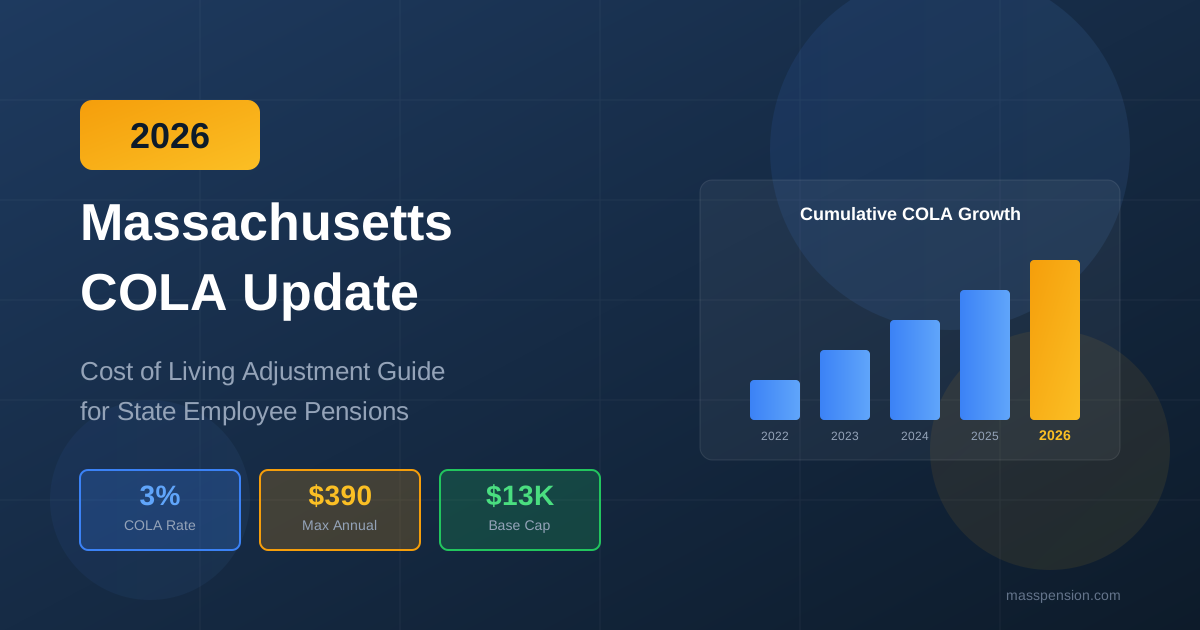
None of that changes the arithmetic our reader is living with. The state COLA applies only to the first $13,000 of an annual pension, a base unchanged since 2012. At the usual 3%, the maximum increase is $390 a year — regardless of inflation, and regardless of the size of your pension. Over the high-inflation years since 2021, that structure has meant a significant loss of purchasing power for anyone whose pension is their primary income. See our deep dive on the $13,000 cap for how the math compounds.
What the COLA Commission actually recommended
This is where our reader's information was out of date — in a good way. The Special COLA Commission's recommendations go further than the “maybe $16,000” figure that circulated earlier. The Commission recommended:
- An immediate increase in the COLA base from $13,000 to $18,000 for state and teacher retirees;
- Raising the base over time toward alignment with Social Security's maximum individual benefit at full retirement age (over $48,000 in 2025);
- A new “Enhanced COLA” for long-term retirees, who have seen the deepest erosion of purchasing power;
- Funding the change using a share (about 15%) of the fund's strong 2025 investment gains — structured, in the Commission's words, so the proposals do not require additional Commonwealth contributions to the ongoing pension funding schedule.
In other words: the mechanism our reader proposed — using the fund's investment performance to finance a better COLA — is essentially what the Commission put on the table. The debate is no longer whether the money could come from investment gains, but whether the Legislature will enact it.
What has to happen next
Commission recommendations are not law. To change your COLA, the Legislature must pass a bill and the Governor must sign it. Here is where the legislation actually stands as of early August 2026:
- S.1817 (Sen. Cyr) is the live vehicle: the Public Service Committee reported it favorably on April 8, 2026, and it now sits with the Senate Committee on Ways and Means — the step where proposals either get funded or quietly stall.
- H.2812, the House companion, was sent to a study order on March 30, 2026 — the Legislature's customary way of shelving a bill for the session. The Senate bill carries the effort from here.
If you want to follow or weigh in:
- Mass Retirees Association (massretirees.com) tracks the COLA legislation closely and organizes member advocacy;
- The MTA publishes fact sheets on the COLA bills for educator retirees;
- Your own state representative and senator are the people who will actually vote on it.
The bottom line for your planning
Until a bill is signed, the prudent move is to plan on current law: COLA on the first $13,000 only, a maximum of $390 a year. Our pension calculator projects your benefit under today's rules, so any base increase that passes would be upside, not something your plan depends on. If the $18,000 base becomes law, a 3% COLA year would mean up to $540 — a meaningful improvement, though still far from full inflation protection on a typical pension.
And to our reader: thank you for the question. You were right about the important part — the fund's gains are the leading proposal for how a better COLA gets paid for. The place that decision gets made, though, is the State House, not PRIM.
Sources: PRIM Board (mapension.com) fund and governance information; Special COLA Commission draft principles and recommendations (mass.gov); Mass Retirees Association coverage of the Commission's recommendations (massretirees.com, March 2026); MTA COLA legislation fact sheet (H.2812/S.1817); bill status and history via malegislature.gov (S.1817, H.2812); public funded-status reporting for the State and Teachers' systems. Figures as of mid-2026 — fund value, funded ratios, and legislative status change; confirm current numbers with official sources.